Configuration

Using graphical interface

Options are accessible through the Settings tab:
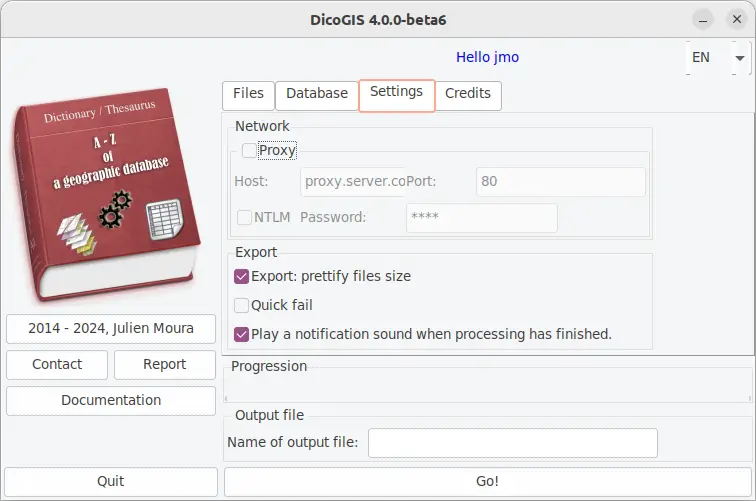
DicoGIS GUI settings tags

Publishing previously exported metadata (JSON files) to a uData catalog is done through the Publish tab: pick the folder containing the JSON files, fill in the uData catalog connection (API URL, version, key, and optionally an organization ID), then use the Launch button.

Using environment variables

Some options and arguments can be set with environment variables. When a GUI widget exists for one of them (see the Settings tab above), the environment variable only sets its initial value: the widget can override it, and the choice persists across runs in options.ini.

Shared (CLI and GUI)

Variable name

Corresponding CLI argument

Default value

DICOGIS_DEBUG

--verbose

false

DICOGIS_ENABLE_NOTIFICATION_SOUND

--opt-notify-sound / --no-opt-notify-sound

true

DICOGIS_EXPORT_RAW_PATH

--opt-raw-path

false

DICOGIS_EXPORT_SIZE_PRETTIFY

--opt-prettify-size / --no-opt-prettify-size

false

DICOGIS_LISTING_MAX_WORKERS

--listing-max-workers

unset (auto, based on CPU count)

DICOGIS_LISTING_PARALLEL_SCAN

--opt-parallel-scan / --no-opt-parallel-scan

false

DICOGIS_QUICK_FAIL

--opt-quick-fail

false

About the parallel folder scan

DICOGIS_LISTING_PARALLEL_SCAN scans the top-level subfolders of the target folder in parallel worker threads instead of a single sequential walk. It is off by default, and enabling it is not always a win: the per-file work is mostly CPU-bound Python, so on local or otherwise fast storage the threads mainly contend for the GIL and the scan gets slower (benchmarked at ~11x slower on a local disk). It pays off on high-latency storage — typically a network-mounted share — and the deeper the folder tree, the more it helps (~5x faster on a 32-folder tree over a simulated 3 ms/scandir() link).

Rule of thumb: leave it off, and turn it on only when scanning a location you know is slow to browse. DICOGIS_LISTING_MAX_WORKERS caps the number of worker threads used when it’s enabled (it is ignored otherwise); leave it unset to let Python size the pool from the CPU count. In the GUI, the equivalent spinbox uses 0 to mean “auto”.

GUI only

Variable name

Description

Default value

DICOGIS_UI_STYLE

UI style. Can be any Qt style available on the running platform (e.g. Fusion, Windows)

unset (uses the Qt platform default)

CLI only — inventory subcommand

Variable name

Corresponding CLI argument

Default value

DICOGIS_DEFAULT_LANGUAGE

--language

None

DICOGIS_FORMATS_LIST

--formats

dxf,esri_shapefile,geojson,gml,kml,mapinfo_tab,sqlite,ecw,geotiff,jpeg

DICOGIS_OPEN_OUTPUT

--opt-open-output / --no-opt-open-output

true

DICOGIS_OUTPUT_FILEPATH

--output-path

None

DICOGIS_OUTPUT_FORMAT

--output-format

excel

DICOGIS_POSTGRES_SERVICES

--pg-services

None

DICOGIS_START_FOLDER

--input-folder

None

Shared (CLI publish subcommand and GUI Publish tab)

These set the initial value of their Publish tab widget, same as the “Shared” table above, except DICOGIS_UDATA_API_KEY: for security, the API key typed into the GUI is never written to options.ini, so it must be re-entered (or re-exposed through the environment variable) on every run.

Variable name

Corresponding CLI argument

Default value

DICOGIS_PUBLISH_INPUT_FOLDER

--input-folder

None

DICOGIS_UDATA_API_KEY

--udata-api-key

None

DICOGIS_UDATA_API_URL_BASE

--udata-api-url-base

https://demo.data.gouv.fr/api/

DICOGIS_UDATA_API_VERSION

--udata-api-version

1

DICOGIS_UDATA_ORGANIZATION_ID

--udata-organization-id

None